

You’re More Qualified for That Job Than You Think—Here’s How to Prove It
- Advertisement -
Graphics by: Caitlin Schneider  Graphics by: Caitlin Schneider
It’s week three of the semester. You’ve color-coded your class schedule and snuck in at least one scroll through job listings you’re nowhere near ready to apply for. (Yet.) But the connection between what you’re learning right now and the job you’ll want later starts way sooner than you think. That group project you’re already dreading? Consider it portfolio fodder.
I remember applying for jobs after college (universally known as the trenches) and immediately convinced myself I wasn’t qualified. Every posting wanted 5+ years of experience, every skill under the sun, and basically the Medal of Honor. Looking back, my problem wasn’t a lack of experience—it was a lack of confidence in the experience I already had. I was so focused on what I hadn’t done that I missed how much college had already prepared me.
The trick is turning that experience into something you can actually use—which is exactly what Adobe’s Student Spaces in Acrobat helps you do. It turns your schoolwork into something you can show off to prove what you know. It’s one of those tools I wish I had before I spent so much time worrying I needed 17 internships and a CEO father to be qualified (bonus: it’s free).
In this article 1 Yes, your college work counts as “prior work experience” 2 Turn your interview prep into a study plan 3 Practice talking about what you already know 4 Make interview prep work around your life 5 Stop waiting to feel qualified
Yes, your college work counts as “prior work experience”
When you’re a recent grad, it’s fair to assume that only a previous job counts as experience. An internship counts, maybe. But a class project? A presentation? A research paper you spent three weeks obsessing over? Those just felt like… school. Child’s play.
The problem is that a lot of the things employers were asking for were skills I’d already practiced in college. I had collaborated on group projects, presented research, managed deadlines, worked through disagreements, and learned how to take a giant amount of information and turn it into something that made sense. I just wasn’t thinking about those things as professional skills.
For example, Student Spaces in Acrobat‘s presentation feature can turn shared research into something tangible, which gives you an actual piece of work you can reference when you’re trying to explain what you did in college. A group project isn’t just a grade anymore—it can become a concrete example of how you worked with a team, organized information, and communicated an idea. If I’d been thinking about my college work this way when I was job hunting, I probably would have had a much easier time answering those interview questions that start with, “Tell me about a time you…”
The takeaway
Don’t dismiss something just because you did it for a class. Ask yourself what skill it proves. You might be sitting on way more “experience” than you realize.
Start using Student Spaces for free!
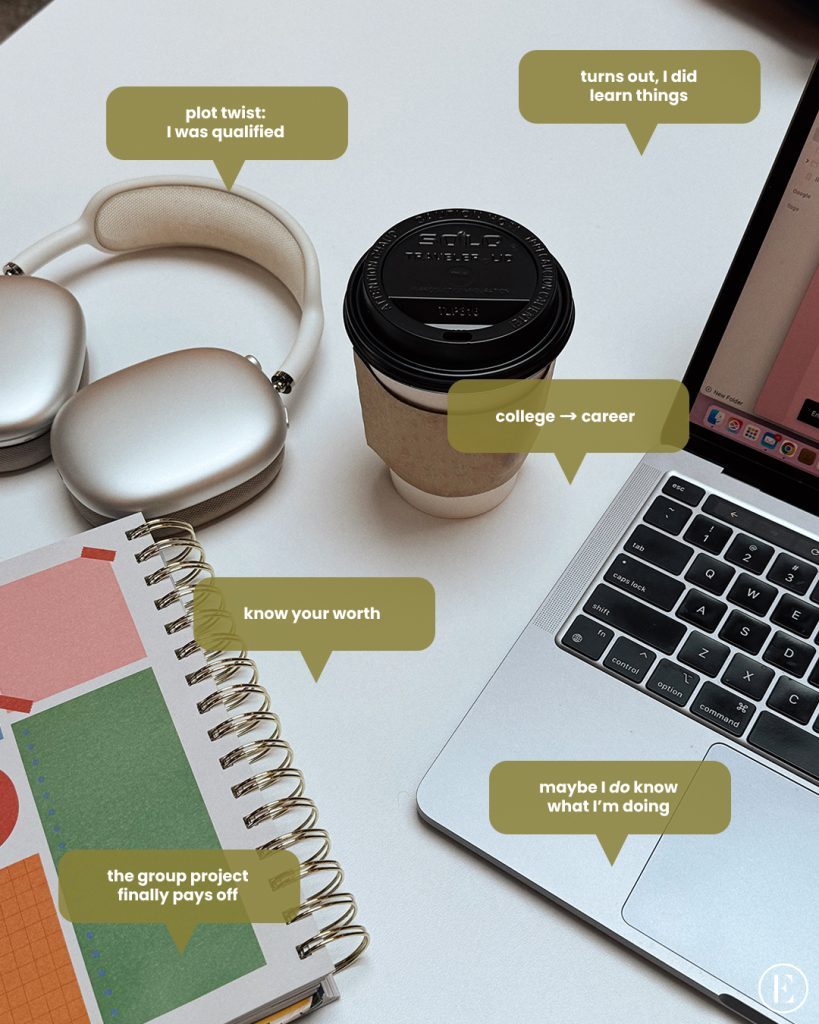 Graphics by: Caitlin Schneider
Turn your interview prep into a study plan
Interview prep was probably the part of job hunting that made me question myself the most. Everything I’d ever done in my life disappeared from my brain, and I’d get stuck on trying to curate perfect answers rather than ones that actually felt, well, true to me. I’d make a mental list of everything I needed to research, every question I should practice, and every example from my past that I could possibly use—and promptly do none of it because I got too overwhelmed. Eventually, it dawned on me that I didn’t need more preparation. I needed better structure.
Student Spaces‘ summary sheet feature grabs everything you’ve gathered for an interview (the job posting, your notes, that one document where you dumped every talking point) and turns it into one clean, formatted page in seconds. It pulls straight from your own sources and auto-fills your name and date, so there’s zero setup on your end. Toggle between half-page, full-page, or two-page on the fly. No formatting. No hunting through a doc for what matters. Just the stuff you actually need to review, ready to go.
The takeaway
If you’re overwhelmed by interview prep, don’t try to do everything at once. Treat the job description like a syllabus and give yourself a plan.
READ MORE: Gen-Zers Opting for “Portfolio Careers” Are Proving to Have More Flexibility and Financial Stability
Practice talking about what you already know
Here’s something no one tells you about your first job search: Knowing something and confidently talking about it are two very different skills. I could write a 10-page paper about a topic and feel completely confident in my research. But ask me about it in an interview? It’s crickets.
A big part of building confidence is practicing how to explain your experience in a way that sounds natural—not like you memorized a paragraph from your resume. With Student Spaces, you can rehearse your answers using the AI Assistant feature, giving yourself a chance to practice explaining your experience in different ways before you’re sitting across from an actual interviewer. The goal isn’t to memorize the “perfect” response; it’s to get more comfortable putting what you already know into your own words.
The takeaway
Practice explaining what you know out loud. Confidence often comes from realizing, “Oh wait, I actually do know what I’m talking about,” instead of stuttering over a script you desperately tried to ingrain into your mind.
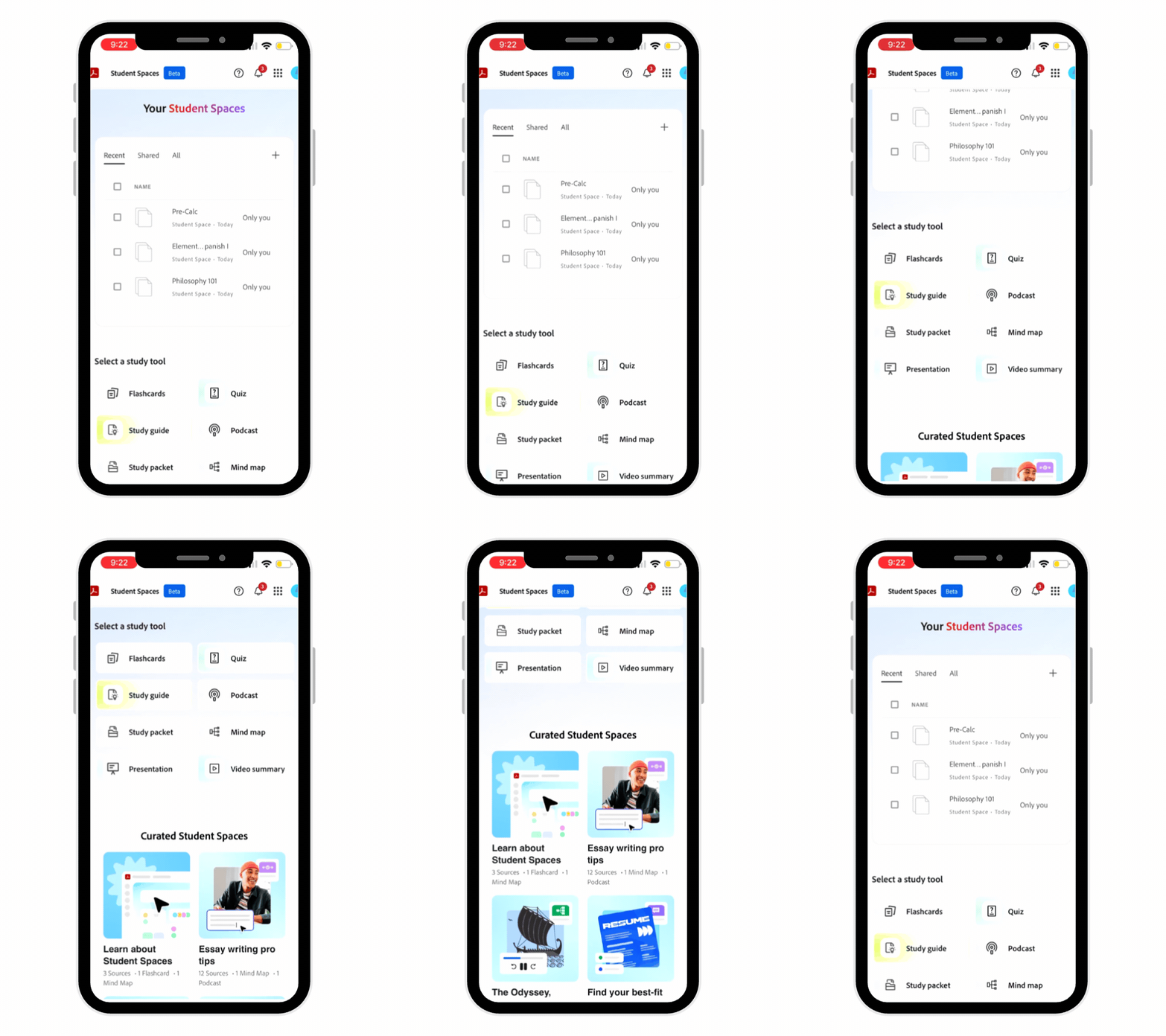 Adobe Acrobat Student Spaces
A free study organization app that transforms your existing notes, slides, and readings into flashcards, quizzes, audio summaries, and personalized plans—all in one place.
Shop Now
Make interview prep work around your life
I can confidently say that staring at a screen for countless hours and de-prioritizing any balance in my life NEVER made me feel more prepared for an interview. Was I now living at my parents’ house away from all my friends? Well, yes. But I still didn’t want to dedicate every waking moment to my desk and LinkedIn job boards. So, if I could get up and moving for a change of scenery while still being productive, that’s the dream.
Student Spaces‘ audio summaries are made for exactly that kind of flexibility. You can turn notes, research, or other uploaded materials into something you can listen to while you’re walking, commuting, or doing whatever else you have going on. I could have reviewed a job description or my notes on the go while on a hot girl walk instead of feeling like interview preparation required me to stay stagnant with minimal blinking.
The takeaway
Preparing for a job doesn’t have to mean locking yourself at your desk. Find ways to review information that fit into the life you’re already living.
Stop waiting to feel qualified
If there’s literally one thing I wish I could tell myself during those first few months after graduation, it’s this: You are probably never going to feel 100 percent qualified for the job before you apply for it. I spent so much time treating job descriptions like do-or-die checklists. If I didn’t meet every single bullet point, I assumed there was no point in applying. If another candidate had more experience than me, I assumed they’d be the obvious choice. And every rejection felt like confirmation that I wasn’t ready yet.
But eventually, I realized that confidence doesn’t come from suddenly becoming the most qualified person in the applicant pool. It comes from being able to look at what you’ve done, understand what you’re capable of, and actually make the case for yourself. That’s where a tool like Student Spaces makes sense for recent grads. It isn’t about manufacturing experience you don’t have. It’s about helping you get more out of the experience you’ve already spent years building.
At the end of the day, all you really need while applying and interviewing is knowing what you bring to the table. And sometimes, that’s the difference between reading a job description and thinking, “I’m not qualified,” and reading it and realizing, “Wait, I’ve actually done this.”
Start using Student Spaces for free!